


Initiatives

Through its flagship initiatives, NMQF leverages data-driven approaches to identify and analyze disparities in healthcare outcomes, allowing for targeted interventions.

background img
background illustration
news image

Cancer Stage Shifting Initiative

The mission of the Cancer Stage Shifting Initiative is to move us from late stage to early- stage diagnosis and treatment of cancer, improving cancer care and reducing cancer deaths for all, with a particular focus on equity and underrepresented populations.
Learn More
arrow icon
news image

Centering Equity Initiative

Launched in 2021 under the Institute for Equity in Health Policy and Practice, CEI examines how the systems that develop, finance, and deliver care were never designed to sustain health for every population. Its annual survey and roundtable identify structural processes that increase patient risk.
Learn More
arrow icon
news image

Faith Health Alliance Advocacy Council

Healthcare industry leaders committed to promoting sustainable health equity through partnership with church leaders nationwide.
Learn More
arrow icon
news image

Nephrologists for Equitable Kidney Care

Collaborative network of nephrologists, healthcare professionals, and advocates dedicated to addressing disparities in kidney care and ensuring equitable access to optimal treatment for all, particularly in underserved communities.
Learn More
arrow icon
news image

Alliance for Representative Clinical Trials (ARC)

A national network of community-based clinicians—many from Federally Qualified Health Centers (FQHCs)—working to increase diversity and inclusion in clinical research by bringing clinical trials to underrepresented communities. Through the PI Institute, ARC equips clinicians with the training and resources to serve as principal investigators and lead high-quality trials within their own communities.
Learn More
arrow icon
news image

Data Equity Coalition

Co-convened by the National Minority Quality Forum, the Data Equity Coalition brings together health, research, policy, and community organizations to advance inclusive and standardized collection of race, ethnicity, language, sexual orientation, and gender identity data. Through education, policy advocacy, and collective action, the coalition works to ensure that health data accurately represents every community and supports more equitable health outcomes.
Learn More
arrow icon
news image

CKM Health Collaborative

A partnership between NMQF and the Association of Black Cardiologists addressing the interconnected burden of cardiovascular, kidney, and metabolic disease, built on four pillars: data, community engagement, policy and advocacy, and clinical practice.
Learn More
arrow icon
news image

Clinical Trial Learning Community

A partnership with Biogen building clinical research awareness and access through disease education, trusted community partnerships, bilingual resources, and patient storytelling. Active across lupus, Alzheimer's, and kidney disease.
Learn More
arrow icon
news image

Minority and Rural Coronavirus Insights Study (MRCIS)

A five-year prospective study integrating participant surveys, medical records, and biobanked specimens across California, Louisiana, and Florida to examine how pandemics compound existing disparities in health outcomes.
Learn More
arrow icon
news image

ChatNMQF

A secure, AI-powered platform that answers plain-language questions from NMQF's data environment — no coding required. Researchers, clinicians, advocates, and policymakers can explore disease burden by ZIP code, county, or legislative district.
Learn More
arrow icon
news image

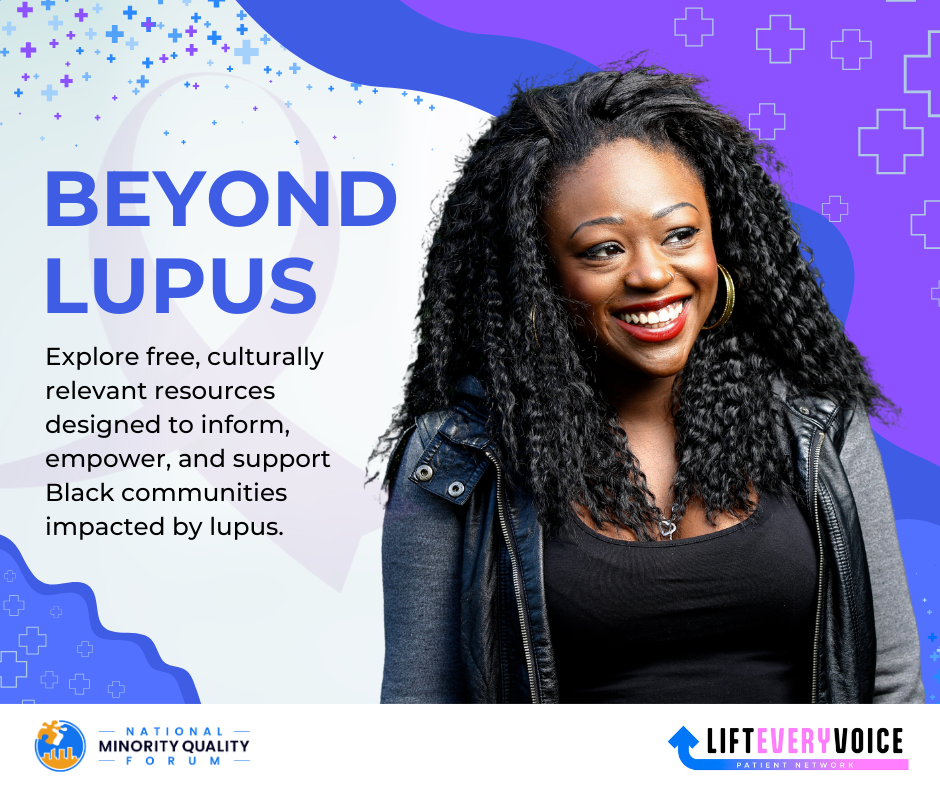
National Lupus Outreach and Clinical Trial Education Program

Supported by the HHS Office of Minority Health, this program mobilizes multiple NMQF Centers to build trusted community education around lupus, research participation, and treatment access through faith leaders, barbers, and stylists.
Learn More
arrow icon
news image

Flint LEADS

In partnership with the Michigan Department of Health and Human Services, Flint LEADS examines cancer screening infrastructure and future study opportunities in a city shaped by environmental harm — with community trust at the center of the design.
Learn More
arrow icon