

20 Aug
Date & Time: 12:00 PM ET / 9:00 AM PT
Location: Zoom Webinar
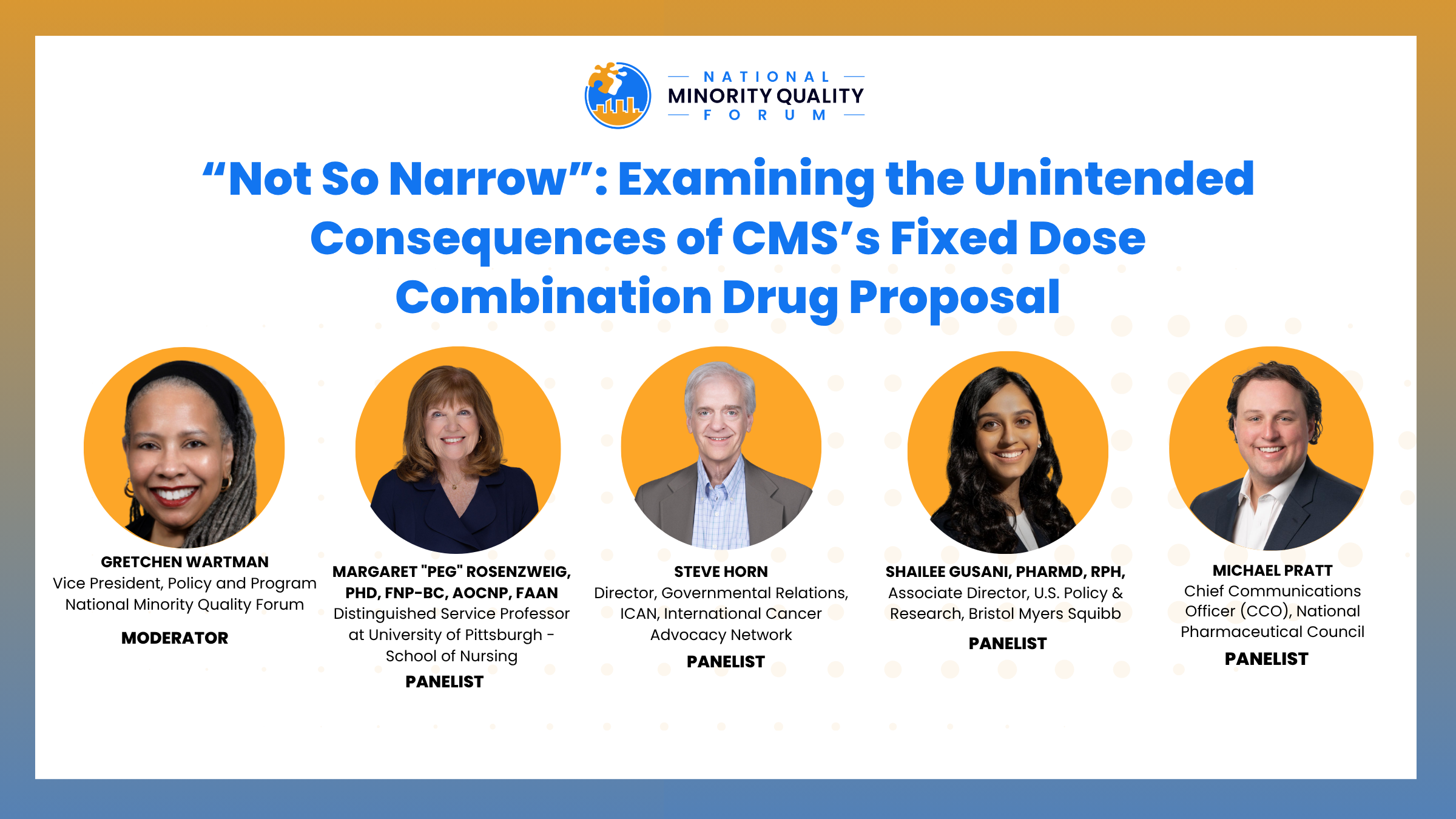
The CMS Fixed-Dose Combination Drug Proposal could significantly affect Medicare beneficiaries, patient access to innovative cancer treatments, healthcare equity, and future pharmaceutical innovation. While the proposal focuses on how certain fixed-dose combination therapies are treated under the Medicare Drug Price Negotiation Program, its implications could extend far beyond drug pricing.
Join the National Minority Quality Forum (NMQF) for “Not So Narrow”: Examining the Unintended Consequences of CMS’s Fixed-Dose Combination Drug Proposal, a timely webinar exploring how these proposed policy changes may affect patients, providers, researchers, and the future of healthcare innovation.
CMS has proposed changes to the treatment of certain fixed-dose combination therapies under the Medicare Drug Price Negotiation Program. Although technical in nature, these changes could influence patient access to treatment, treatment experience, healthcare equity, and the development of future therapies.
Fixed-dose combination therapies often provide patients with more convenient treatment options by simplifying medication regimens and reducing the number of administrations required. For many patients, especially those undergoing cancer treatment, these therapies can help reduce transportation challenges, time away from work, caregiver burden, and other barriers that affect treatment adherence and health outcomes.
This webinar will examine the potential unintended consequences of the proposal for Medicare beneficiaries, clinicians, healthcare providers, researchers, and innovators. Panelists will discuss how reimbursement and pricing policies can influence patient access, treatment options, and future pharmaceutical innovation while considering whether current policy approaches fully recognize the value these therapies provide.
The discussion will also explore what these changes could mean for healthcare equity, particularly for communities that already face significant barriers to accessing timely, high-quality care.
Healthcare policies can have unintended consequences that disproportionately affect historically underserved communities. More convenient forms of treatment may help reduce transportation barriers, time away from work, employment challenges, and other social factors that influence whether patients are able to receive and complete recommended care.
This conversation will examine how thoughtful policymaking can balance affordability with continued innovation while ensuring equitable access to effective therapies for all patients.
The webinar builds upon the featured Health Affairs article:
“When the Payer Defines the Product: How a Medicare Pricing Rule Would Deepen the Divide in Cancer Care.”
The article examines how CMS’s proposed treatment of fixed-dose combination therapies could affect patient access, treatment options, and health equity—particularly when more convenient forms of cancer treatment help reduce transportation, time, and employment barriers.
Vice President, Policy and Program
National Minority Quality Forum
Gretchen Wartman will moderate the discussion, guiding an expert panel through the policy, clinical, and patient implications of the CMS Fixed-Dose Combination Drug Proposal.
Distinguished Service Professor
University of Pittsburgh School of Nursing
Dr. Rosenzweig is a nationally recognized oncology nurse practitioner, researcher, and educator whose work focuses on neighborhood deprivation, cancer disparities, symptom burden, and community-engaged cancer care. She has authored more than 160 publications and has led numerous NIH-funded research initiatives examining how social and economic conditions shape cancer outcomes.
Director of Governmental Relations
International Cancer Advocacy Network (ICAN)
Steve Horn leads federal, state, and international policy advocacy for ICAN, an organization dedicated to helping Stage IV cancer patients access personalized treatment options, clinical trials, physician referrals, and patient navigation services. His expertise spans healthcare policy, governmental affairs, and patient advocacy.
Associate Director, U.S. Policy & Research
Bristol Myers Squibb
Dr. Gusani specializes in Medicare Part B policy, reimbursement, and federal healthcare policy affecting oncology and hematology. She brings valuable expertise regarding the reimbursement and policy implications of CMS’s proposed fixed-dose combination therapy changes.
Chief Communications Officer
National Pharmaceutical Council
Michael Pratt oversees communications and public affairs for the National Pharmaceutical Council and has more than a decade of experience leading healthcare communications across government, policy, and the biopharmaceutical industry. His experience includes leadership roles with Operation Warp Speed and the U.S. Department of Health and Human Services, where he helped communicate major pharmaceutical and public health initiatives.
This webinar is designed for:
Don’t miss this timely discussion on one of the most important healthcare policy issues currently under consideration. Register today to hear from leading experts as they examine the CMS Fixed-Dose Combination Drug Proposal, its potential impact on patient access and innovation, and what these policy changes could mean for the future of equitable healthcare.





Please contact:
Brandon Garrett, COO: bgarrett@nmqf.org
Lorem ipsum dolor sit amet, consectetur adipiscing elit, sed do eiusmod tempor incididunt ut labore et dolore magna aliqua. Ut enim ad minim veniam, quis nostrud exercitation ullamco laboris nisi ut aliquip ex ea commodo consequat.
Contact Us