

July 23, 2026
By Adjoa Kyerematen
NMQF Endorses the Health Equity and Accountability Act of 2026
Read More
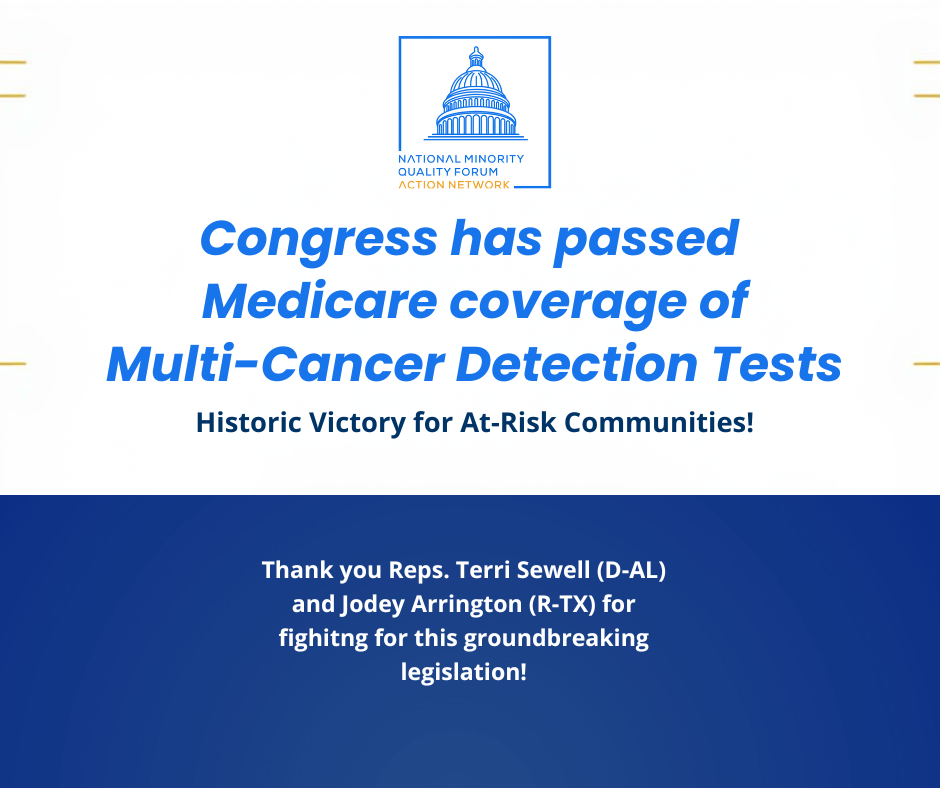
The National Minority Quality Forum Action Network today released the following statement applauding congressional passage of the Nancy Gardner Sewell Medicare Multi-Cancer Early Detection Screening Coverage Act (H.R. 842/S. 339), a critical step toward modernizing cancer detection and addressing persistent inequities in cancer outcomes.
“Over the last several decades, the nation has made significant advances in cancer treatment, yet far too many people—particularly communities of color and those with limited access to care—are still diagnosed too late to fully benefit from those innovations. Nearly 1,400 Medicare beneficiaries receive a late-stage cancer diagnosis every day, reflecting systemic gaps in early and timely detection. Lower-income populations, certain racial and ethnic groups, and geographically isolated communities continue to experience higher cancer mortality, lower use of proven screening tools, and disproportionate rates of advanced disease.
“Multi-cancer early detection represents a paradigm shift toward presymptomatic cancer detection—identifying cancer signals before symptoms appear, when intervention is most effective. By enabling earlier information transfer within the health care system, these technologies create the opportunity for timely clinical action, improved outcomes, and more equitable care.
“Congress has led before in expanding access to life-saving cancer detection tools, including mammography and colonoscopies. With passage of the Nancy Gardner Sewell Medicare Multi-Cancer Early Detection Screening Coverage Act, Congress has once again made history. This legislation establishes a strong foundation for Medicare coverage of multi-cancer early detection tests and creates a clear, evidence-based framework for CMS evaluation and decision-making.
“It is rare to see a health care bill with this level of bipartisan support and long-term impact. We applaud the members of Congress who recognized the urgency of modernizing cancer detection and took decisive action to move the nation closer to a future where earlier diagnosis—and better outcomes—are possible for all.”
###


July 23, 2026
By Adjoa Kyerematen

May 20, 2026
By Adjoa Kyerematen

May 08, 2026
By Subash Kafle

May 07, 2026
By Subash Kafle

April 28, 2026
By Victor Mejia Lacayo
April 27, 2026
By Victor Mejia Lacayo